
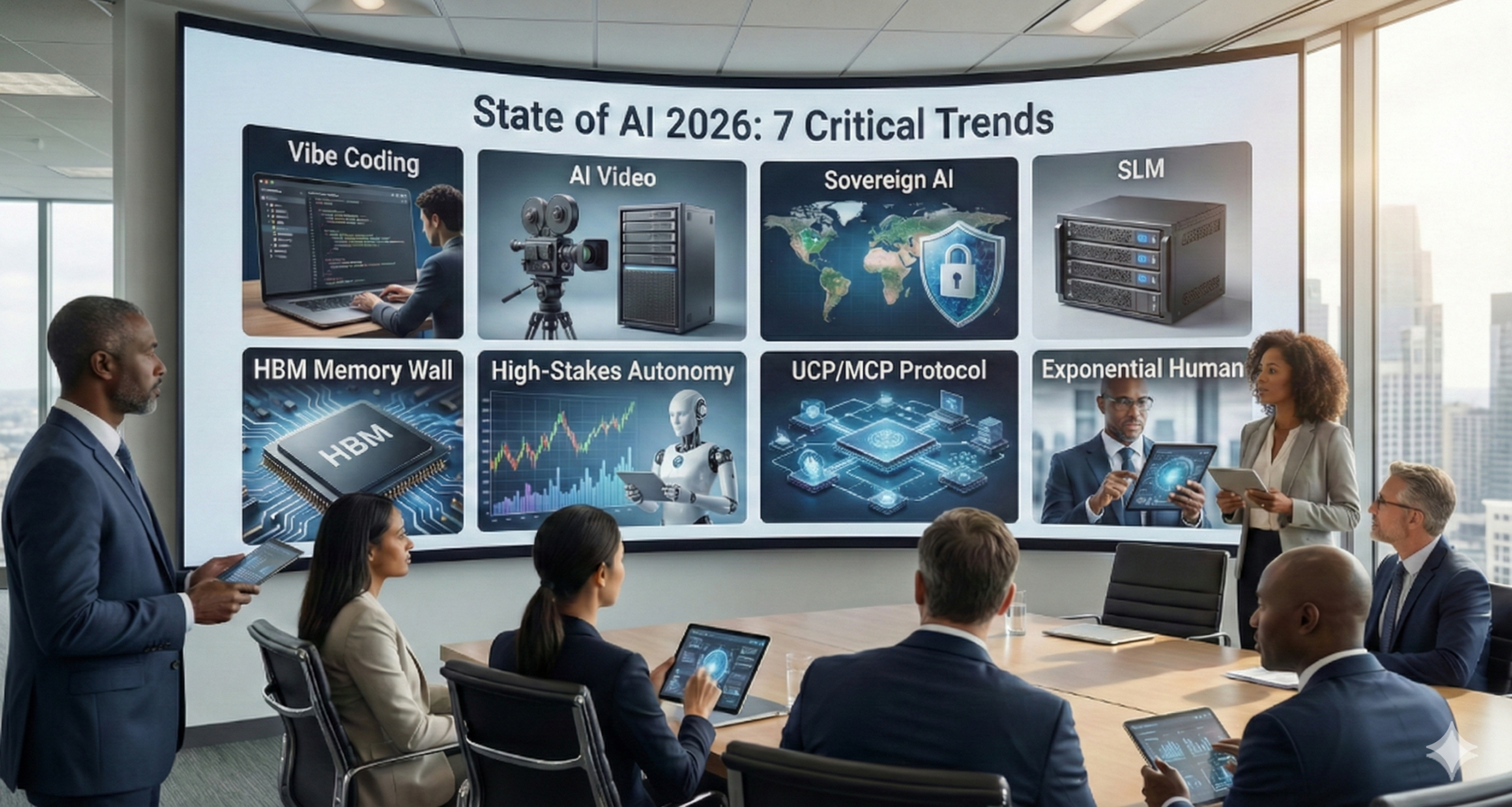
If 2025 was the year of the experiment, 2026 is the year of consequence.
We are exactly three weeks into the new year, and the signals are flashing red. JP Morgan isn’t just testing AI; they’ve handed it the keys to $3.2 trillion in proxy voting. Utah isn’t debating AI healthcare; they just passed a law allowing it to prescribe meds.
The era of the “Proof of Concept” (POC) is over. We are now in the era of Business Model Transformation.
Based on market moves from late 2025 and the massive announcements dropping this January, here are the 7 trends that will define the first half of 2026.
1. The Rise of “Vibe Coding” (Disposable Software)
The Shift: We are moving from buying software to generating it. For decades, if you had a niche problem (e.g., “compress these 500 PDFs for the legacy server”), you bought a SaaS license or hired a dev. Not anymore.
In 2026, non-technical staff are using “Cloud Terminal” interfaces to “vibe code” solutions in minutes. These are single-purpose, disposable applets that exist only as long as the problem exists.
💡 The Takeaway: The “Wrapper Startup” is dead. If your product is just a thin UI over an LLM, a user can now build your entire company in an afternoon.
2. The Year of Video: Production Solved
The Shift: Video creation is finally as easy as email. While 2025 perfected voice and image, 2026 is officially the “Year of Video.” Tools like Sora, Runway, and Google’s Veo have crossed the uncanny valley. We are seeing the cost of high-fidelity video production drop to near zero.
This isn’t just about deepfakes; it’s about enterprise utility. Marketing teams are generating personalized video outreach at scale, and training departments are updating instructional videos in real-time without re-shooting.
💡 The Takeaway: If your 2026 marketing strategy relies on expensive video production agencies, you are already overpaying.
3. The Crisis of Trust & Sovereign AI
The Shift: “Local” is the new “Secure.” With AI video reaching photorealism (Trend #2), trust in digital media is collapsing (projected 15-30% trust rates). The response? Sovereign AI.
Governments and regulated industries are refusing to rely on “black box” models. They are moving to:
-
Local Compute: Data never leaves the laptop (powered by new NPUs).
-
National Models: France, India, and the UAE are building models aligned with their laws and culture, not Silicon Valley’s.
💡 The Takeaway: Data sovereignty isn’t just compliance anymore; it’s a competitive advantage against the crisis of trust.
4. Small Language Models (SLMs) Mean Big Business
The Shift: From “One Giant Brain” to “A Thousand Efficient Workers.” While the media obsesses over massive reasoning models (like the new OpenAI “Pro” series), the enterprise is quietly pivoting to Small Language Models (0.5B to 7B parameters).
Why? Latency and Cost. You don’t need a PhD-level AI to read an invoice. You need something fast, cheap, and hallucination-free. SLMs run efficiently on local hardware, solving the privacy issues mentioned in Trend #3 while slashing cloud costs.
💡 The Takeaway: In H1 2026, the smartest companies aren’t just using the biggest models; they are deploying the smallest possible model that can get the job done.
5. High-Stakes Autonomy (Finance & Health)
The Shift: AI is no longer a co-pilot; it’s the captain.
-
Finance: JP Morgan’s move to automated proxy voting signals a massive concentration of corporate governance power into AI algorithms.
-
Healthcare: Utah’s regulatory sandbox proves that when AI hits 99.2% alignment with human doctors, the laws will change to let it operate autonomously.
💡 The Takeaway: Watch the insurance markets. “Sandbox Insurance” that covers AI liability is the new must-have for 2026.
6. Agents Get a Common Language (UCP & MCP)
The Shift: Agents stop hallucinating and start executing. The biggest frustration of 2025? AI agents couldn’t “do” things because they couldn’t reliably talk to databases. Enter the Unified Commerce Protocol (UCP) and Model Context Protocol (MCP).
These standards allow probabilistic AI (the creative thinker) to talk to deterministic systems (your inventory database) without making things up.
💡 The Takeaway: Stop building Chatbots. Start building Agents that transact.
7. The IT Paradox & The “Exponential Human”
The Shift: Decentralized Innovation. Here is the uncomfortable truth for 2026: Your IT department cannot save you. They lack the business context to transform your Legal or HR workflows.
The winners of 2026 are the “Exponential Humans”—individual employees using multi-agent workflows to do the work of ten people. Successful companies are decentralizing AI, viewing it as a personal responsibility for every employee to go to the “AI Gym” daily.
💡 The Takeaway: Don’t wait for a corporate mandate. The most valuable employees in 2026 are the ones building their own AI workflows.
🔮 What’s Your 2026 Strategy?
The tools are here. The protocols are live. The regulations are shifting. The only question left is: Are you still treating AI as a tech upgrade, or are you ready to rebuild your business model?