
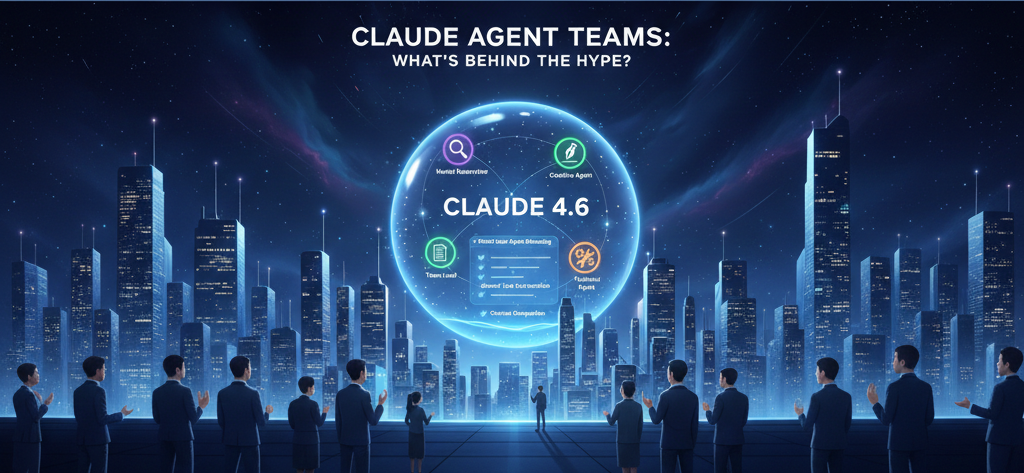
The launch of Claude Opus 4.6 on February 5, 2026, marks a milestone that signals a transition from the chatbot era toward AI workers. The centerpiece of this shift is a feature called Agent Teams.
What are Claude Agent Teams?
At its simplest, an Agent Team is a group of specialized AI instances that work together to solve a single, complex goal.
In the past, you interacted with one AI that tried to be a “jack of all trades.” With Opus 4.6, you interact with a Team Lead. This lead agent has the authority to spin up sub-agents (Teammates) to handle specific parts of a project. Instead of one AI getting overwhelmed by a 50-step plan, you have a coordinated group where each member owns a specific piece of the puzzle.
How do they work?
The “magic” of Agent Teams lies in three architectural breakthroughs that mimic a real-world office:
-
Direct Messaging: Teammates don’t just talk to you; they talk to each other. If a Security Agent finds a flaw in code written by a Developer Agent, it sends a direct message to get it fixed. You are no longer the middleman copy-pasting text between chat windows.
-
Shared Task Orchestration: The Team Lead maintains a live, shared task list. When an agent finishes a sub-task, the system automatically “unblocks” the next step. This allows for parallel work, meaning your marketing copy, technical specs, and budget analysis can all be built at the exact same time.
-
Context Compaction (The “Infinite Memory”): To prevent the AI from “forgetting” details during long projects, Claude now summarizes its own history as it goes. This allows a team to work for days or weeks on a single project without hitting a memory ceiling.
How is this different from what existed before?
Until now, “agents” were mostly a DIY project for engineers. You had to build your own complex logic to make multiple AIs work together.
Claude Opus 4.6 makes this native. The coordination, the task management, and the communication are built directly into the model. It is the difference between buying a box of engine parts and buying a fully functional car. By moving from “Prompting” to “Orchestrating,” AI has finally moved out of the chat box and into the organizational chart.
What can they do for your business?
This technology transforms AI from a “research tool” into a “production engine.”
-
Product Launches: You provide the high-level goals. The Lead Agent spins up a Market Researcher to analyze competitors, a Creative Agent to draft copy, and a Technical Agent to set up the landing page. They coordinate their own deadlines and hand-offs.
-
Financial & Legal Review: You can deploy a team to audit thousands of pages of contracts. One agent flags risky clauses, another compares them to current regulations, and a third synthesizes the findings into an executive summary.
-
Software Development: These teams perform “Adversarial Debugging.” One agent writes the code while another acts as a “Red Team” to try and break it. They go back and forth until the product is hardened for release.
Why does this matter?
This update represents a fundamental shift in how companies scale. Historically, to double your output, you had to double your headcount. Claude Agent Teams provide operational leverage.
A single human manager can now oversee a “digital department” of ten or twenty agents. This allows small startups to operate with the horsepower of a mid-sized corporation and allows large enterprises to eliminate the “bureaucratic lag” that usually happens when projects move between human departments.